
AI's First Substitution: Freelancers
Ramp data shows firms are replacing freelancers with AI…at a steep discount.

Dear Colleagues,
Today’s letter is about a significant economic transformation affecting freelance work. I’m aware many of my subscribers are either freelancers full-time or earn a significant amount of their earnings through freelance work. This letter may not reflect all their experiences, but I do think these findings are representative of some aggregate.
I got this text from a friend last week.
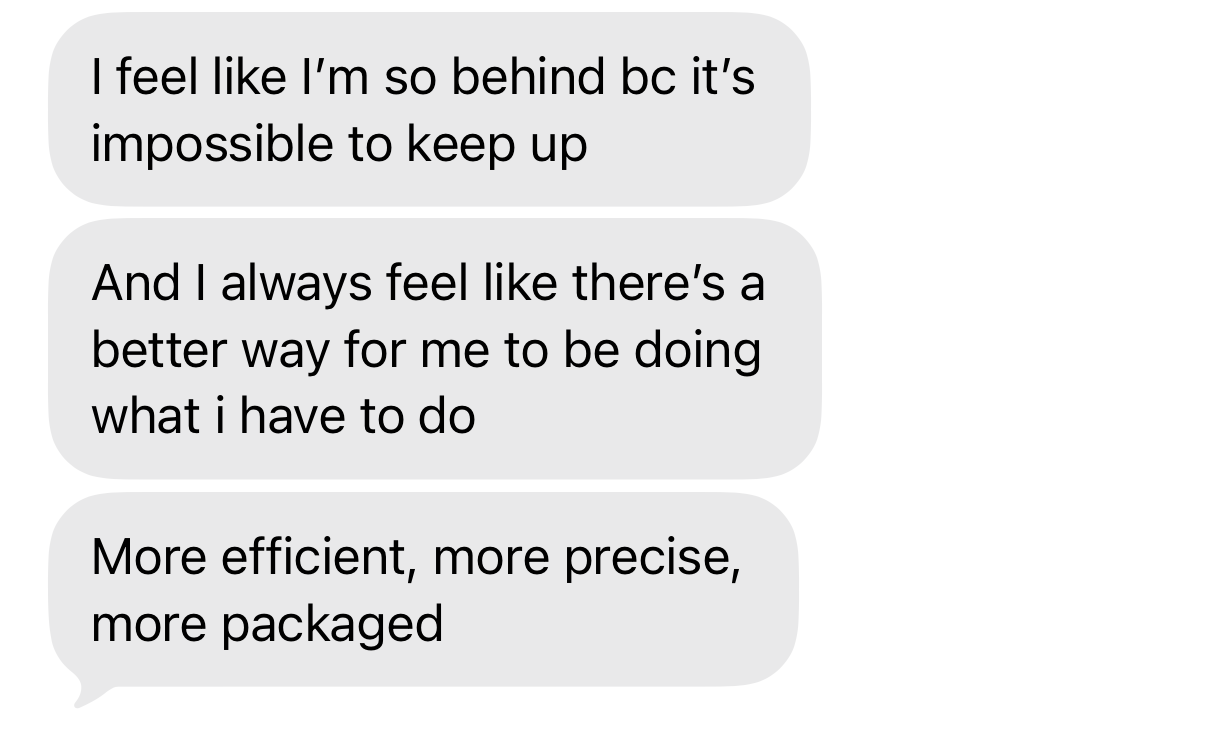
I have similarly never felt more challenged by my profession, where the requirements (to be a good researcher, a clear writer, and earnest curator and distributor of this work) are being dramatically extended. The gap between action and thought is closing, and I would like more time to think.
I’d like to spend some of that time answering your questions about the economy and where we’re headed. If you’d like to see me answer your questions, using Ramp data or otherwise, please send me a message.
Everyone wants to know if AI is replacing workers. The problem is measuring it. The research so far has tracked AI exposed job titles and their respective hiring trends, but the definition of “AI-exposed” shifts every time we get a new model.
The ideal dataset would track firm-level AI adoption alongside hiring, but the labor market is noisy. If you look at the aggregate workforce (nurses, chefs, construction workers), you aren’t going to see the impact for years. It’s too diluted.
So where do you look to see the future? Economists look at the margin. Here, that’s workers with the least friction: freelancers. Because:
Freelancers are heavily exposed to economic transformations already. No severance. No HR process. Companies can let contracts expire and stop posting new ones.
Freelance work is usually defined by tasks, not roles. Writing a blog post, designing a logo, fixing code. These are well-scoped tasks that don’t require a lot of institutional knowledge. And LLMs are really good at them.
That’s the focus of a new paper from Ramp Economics Lab by my colleague Ryan Stevens, Ramp’s Director of Applied Science. He tracked firm-level spending on freelance marketplaces (Upwork, Fiverr) and AI model providers (OpenAI, Anthropic) from 2021 to 2025.
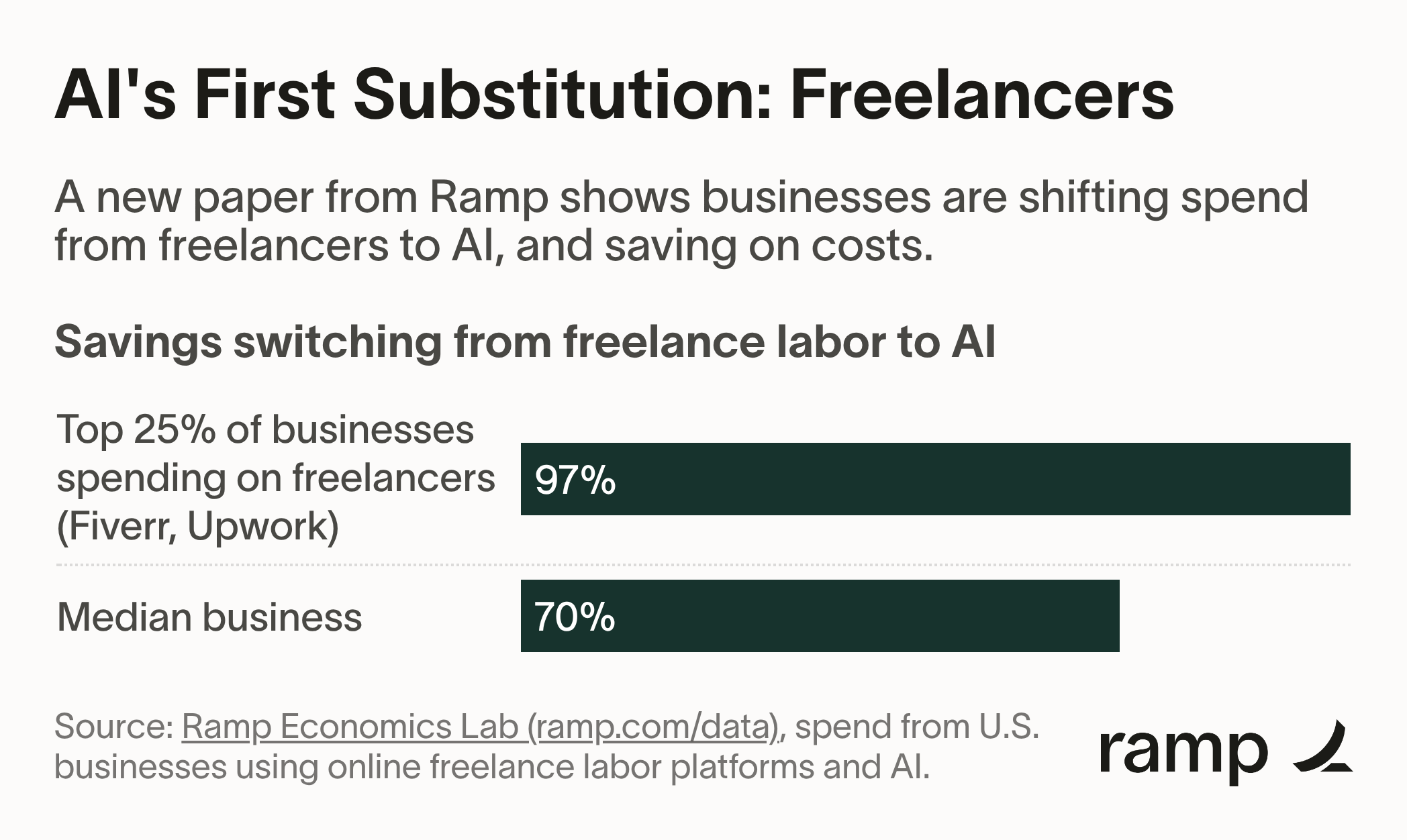
Two findings stand out.
First, businesses are shifting spend from freelancers to AI. The share of total spend going to labor marketplaces fell from 0.66% in Q4 2021 to 0.14% in Q3 2025. AI model provider share rose from zero to nearly 3%. More than half of the businesses using freelancers in 2022 have stopped entirely. And the companies that used to spend the most on freelancers shifted to AI the fastest.
Second, AI is dramatically cheaper. Firms most exposed to AI, those that spent the most on freelancers pre-ChatGPT, substituted at a rate of about $1 in reduced freelance spend for $0.03 in AI spend. That’s roughly 25x cost savings. Even the middle-exposure group showed that for every dollar saved on freelance labor, they spent $0.30 on AI. The true number is probably somewhere in between, but either way: AI is not a 1-for-1 replacement. It’s an order of magnitude cheaper and companies are keeping or re-investing the savings.
These results suggest a blindspot for policymakers. While Americans are concerned that AI will cause permanent job loss, freelancers are in a more precarious position. They lack the protections that come with traditional employment (benefits, unemployment insurance). They’re also outside the standard policy toolkit for managing labor market disruptions. If they’re first in line for displacement, what happens to them?
There’s an irony here. A few years ago, the discourse worried about gig work eroding traditional employment. Uber and Upwork were threats to the social contract. Now the gig economy may be the first victim to automation. Rideshare drivers from self-driving cars. Freelancers to Claude and ChatGPT. The narrative flipped fast.
None of this tells us what aggregate employment will look like in ten years. Micro substitution doesn’t imply macro job loss. AI will create more roles than it destroys, but this first result tells us where the displacement is happening first.
Read Ryan’s full paper for the methodology, with an extensive description of our approach and analysis. This is an area of emerging research – and an important one – where Ramp data will be particularly critical in tracking firm decisionmaking.
Something from my camera roll
Jacob’s water bottle.
It'd be interesting to compare this to data looking at volume of 1099s over time, since this is a reflection solely of spend on labor marketplaces (which is the lowest common denominator of outsourced work), which is really only representative of the bottom of the freelance market. My hypothesis is that this is less a reflection of freelance work overall, and more a reflection of low-skill labor across the the job market being impacted (akin to new grads in the W2 pool).
Obviously this is anecdata, but most companies I know have hired more contractors and freelancers over the past two years as there's been so much pressure to keep headcount low post-2022 correction and now potential AI reductions. But those are typically ongoing relationships vs one-off task work assigned via labor marketplaces.
Thanks for this and especially for the paper: Payrolls to Prompts: Firm-Level Evidence on the
Substitution of Labor for AI.